
LegisTech Conference Dublin: Parliaments Advance a Shared Agenda for Artificial Intelligence and Digital Modernisation
Event co-organized by Bússola Tech and the Houses of the Oireachtas, Parliament of Ireland in Dublin, between June 3rd and June 5th, 2026

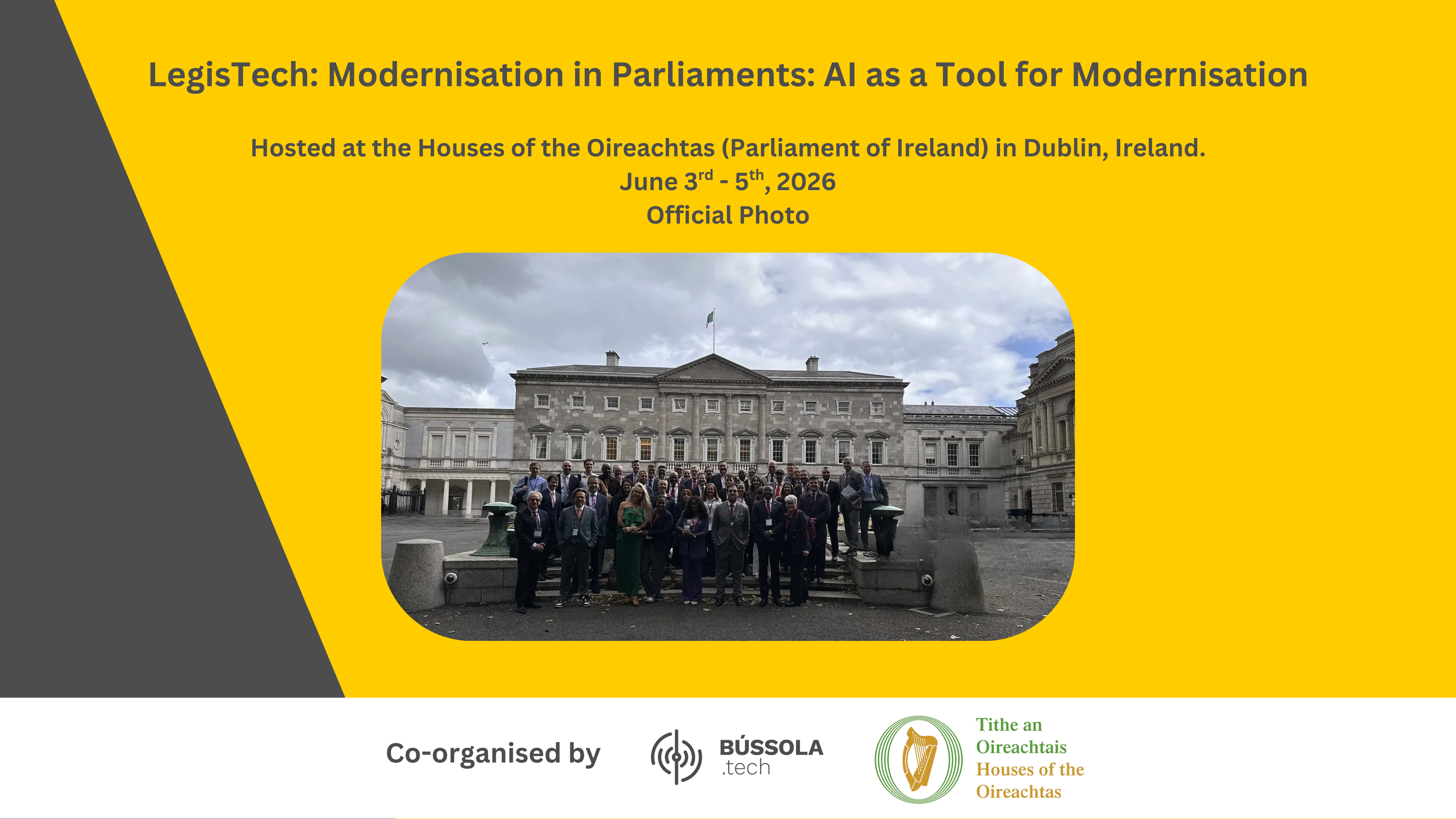
Photos of the event at the end of the publication.
Dublin, Ireland — Bússola Tech and the Houses of the Oireachtas, the Parliament of Ireland, have concluded the 2026 edition of LegisTech: Modernisation in Parliaments – AI as a Tool for Modernisation, held from 3 to 5 June in Dublin.
The three-day international conference brought together senior parliamentary officials, secretaries-general, clerks, legislative counsel, technology leaders, public-sector innovators, academics and institutional partners from legislative institutions across Africa, the Americas, Europe, Asia and Oceania. The programme examined how parliaments can adopt artificial intelligence responsibly while strengthening the institutional foundations required for sustainable digital transformation.
Across plenary panels, technical discussions, thematic breakout sessions and demonstrations of parliamentary digital systems, LegisTech 2026 addressed the full ecosystem required for modernisation: digital maturity assessment; modular and interoperable platforms; agentic artificial intelligence; data governance and standards; AI-ready legislative data; cybersecurity; incident response; continuity planning; accessibility; communications; disinformation; institutional guardrails; legislative procedure; ex-post legislative scrutiny; legacy systems; financial planning; infrastructure; and political and administrative support for long-term transformation.
The conference opened with remarks from Ciarán Doyle, Assistant Secretary of the Houses of the Oireachtas; Luís Kimaid, Executive Director of Bússola Tech; and José Pedro Montero, President of the Association of Secretaries-General of Parliaments (ASGP) and Secretary-General of the Cámara de Senadores of Uruguay. Their participation established the institutional character of the event: artificial intelligence and digital modernisation were considered not as isolated technology projects, but as long-term parliamentary priorities involving governance, procedure, human capacity, infrastructure and democratic legitimacy.
Building the Digital Foundations for Modern Parliaments
The first day focused on the structural, organisational and technological foundations of parliamentary modernisation.
A panel on the modularisation, integration and tailoring of digital platforms and services in parliaments was moderated by Luís Kimaid and brought together Neemias Muachendo, IT Director at the Assembleia Nacional of Angola; Kirsten Gullickson, Director of Systems Analysis and Quality Assurance at the Office of the Clerk of the U.S. House of Representatives; Mairéad Keating, Head of Parliamentary Business Systems Development at the Houses of the Oireachtas; and Juliano Bringer, CIO at Ágape Consulting. The discussion considered how legislative institutions can move away from fragmented systems and towards interoperable, adaptable and sustainable digital services capable of supporting parliamentary business over time.
The programme then addressed the growing relevance of agentic artificial intelligence in parliamentary environments. Moderated by Ciarán Doyle, the session included Ahto Saks, Administrative Director at the Parliament of Estonia; Stephen Dwyer, Senior Innovation Director at the U.S. House of Representatives; Bruno Thomasi, CEO of Govsys; and Kieran McCorry, National Technology Officer at Microsoft. The panel considered the implications of increasingly autonomous AI-enabled systems for institutional workflows, service delivery, governance and accountability.
The first morning concluded with a session on the evaluation of digital maturity in parliamentary business and services, moderated by Ludovic Delepine, Head of IT Governance and Enterprise Architecture at the European Parliament. The discussion featured Fotis Fitsilis, Head of Scientific Documentation and Supervision at the Hellenic Parliament; Ciarán Doyle; and Fuat Bayramoglu, Legislative Expert at the Grand National Assembly of Turkey. Participants examined the importance of assessing institutional readiness before pursuing advanced technology initiatives, including the maturity of data, processes, governance arrangements, skills and digital infrastructure.
The afternoon thematic trails allowed participants to deepen the discussion in smaller working environments.
The Governance and Administration trail was chaired by Ciarán Doyle and featured contributions from Kirsten Gullickson; Mary Tougher, Programme Manager at the Houses of the Oireachtas; Fuat Bayramoglu; and Daniel Schuman, Executive Director of the American Governance Institute. The discussion examined the administrative structures, leadership arrangements and institutional decision-making processes necessary to support digital transformation.
A parallel session on the use of artificial intelligence in cybersecurity to combat AI-powered attacks was chaired by Fotis Fitsilis. It brought together Graeme Smith, Cybersecurity Programme Manager at the Houses of the Oireachtas; Jack Turner, Cybersecurity Governance, Risk and Compliance Officer at the Houses of the Oireachtas; and Franklin De Vrieze, Head of Practice Accountability at the Westminster Foundation for Democracy. The session addressed the need for parliamentary institutions to prepare for increasingly sophisticated cyber threats, including attacks enabled or accelerated by artificial intelligence.
The third trail, on innovation and AI-assisted development of digital solutions in parliaments, was chaired by Colm Kealy, Programme Manager at the Houses of the Oireachtas. Speakers included Cillian Hamel, Data and AI Consultant at the Houses of the Oireachtas; Juliano Bringer; and Ludovic Delepine. The discussion explored the operational conditions through which parliaments can experiment, develop, test and scale new digital solutions while preserving institutional continuity and security.
Data, Digital Services, Cybersecurity and Institutional Guardrails
The second day placed particular emphasis on the governance of parliamentary data, the delivery of digital services to Members, resilience against cyber incidents and the institutional safeguards required for responsible AI adoption.
A panel on data governance and standards in parliaments: preparing parliamentary data for AI integration was moderated by Ciarán Doyle. It brought together Monica Palmirani, Professor at the University of Bologna; Grant Vergottini, CEO of Xcential Legislative Technologies; Ambrósio Soares, ICT Center Coordinator at the Assembleia da República of Mozambique; and Fotis Fitsilis. The session examined how structured, accessible, standardised and trustworthy parliamentary data can become the essential foundation for meaningful AI integration, whether in legislative drafting, research, committee work, document management or public-facing services.
The following session addressed engagement, delivery and prioritisation of Members’ digital services. Moderated by Ambrósio Soares, the panel featured Ana Rita Laranjeira of the Assembleia da República of Portugal; Marcos Aquino, CEO of Ágape Consulting; Stephen Dwyer; and Juan de Dios Cincunegui, Advisor at the Chamber of Deputies of Argentina. Participants considered how digital transformation should remain connected to the day-to-day needs of Members, parliamentary staff and legislative processes, rather than being driven solely by technological opportunity.
Cybersecurity remained a central theme throughout the conference. A session on parliament-specific incident response for business continuity and disaster recovery was moderated by Neemias Muachendo and included Graeme Smith, Sara Fernandes, Head of the Information Security Division at the Assembleia da República of Portugal, and Franklin De Vrieze. The discussion focused on the particular operational sensitivities of parliamentary institutions, whose continuity is essential to democratic governance and whose technology environments must be resilient in the face of disruption.
LegisTech also examined the challenge of preserving trust in parliamentary information in a rapidly changing media environment. A panel on parliamentary content and weaponised media in the era of disinformation was moderated by Luís Kimaid and featured James Pinnell, Deputy Director for Programmes at the Commonwealth Parliamentary Association; Derek Luyten, Executive Director of the House Democracy Partnership at the U.S. House of Representatives; and Michelle Conville, Assistant Principal Officer in the Communications Unit at the Houses of the Oireachtas. The session considered how parliaments can respond to synthetic media, manipulated content, malicious information campaigns and new forms of public distrust.
The afternoon also included a plenary discussion on preparing AI guardrails for parliament, moderated by Ciarán Doyle. Contributors included Wade Ballou, retired Chief Legislative Counsel at the U.S. House of Representatives; Fuat Bayramoglu; Tim De Bondt, Head of the Communications Department at the Sénat of Belgium; Luís Fernando Pires Machado; and Fillemon Johannes, IT Director at the Parliament of Namibia. The discussion focused on the institutional rules, accountability mechanisms, human oversight arrangements, ethical considerations and legal safeguards required before artificial intelligence is embedded in parliamentary work.
The second day’s thematic trails translated these discussions into more specialised exchanges.
The Building Parliamentary AI Assistants trail was chaired by Ciarán Doyle and featured Bilal Munir, Data and AI Manager at the Houses of the Oireachtas; Sola Adewumi, IT Manager at the Houses of the Oireachtas; Bruno Thomasi; Ludovic Delepine; and Stephen Dwyer. Participants considered practical questions surrounding the design, deployment and governance of AI assistants for parliamentary users.
The session on Data Governance and Standards for AI Integration in Parliaments was chaired by Jude Wilson, Chief Technology Officer at the Houses of the Oireachtas. It included Marcos Aquino, Monica Palmirani, Grant Vergottini and Fotis Fitsilis. The discussion reinforced the importance of interoperable structures, clear metadata, legislative data standards and institutional stewardship of information.
A third trail on Technology and Infrastructure for a Digital Parliament was chaired by Luís Kimaid. It brought together Marty Bickford, Vice-President at Xcential Legislative Technologies; Kirsten Gullickson; Juliano Bringer; Neemias Muachendo; and Carlos Rocca, Director-General of the Cámara de Representantes of Uruguay. The session examined the infrastructure, systems architecture, procurement, internal capacity and long-term planning necessary to support a fully digital parliamentary environment.
Participants also visited the chamber floor and received a demonstration of the Houses of the Oireachtas’ digital systems, providing an opportunity to examine how institutional digital transformation can be implemented in practice within an active parliamentary setting.
Procedure, Scrutiny, Legacy Systems and Long-Term Continuity
The final day focused on the legal, procedural, financial and political dimensions of digital transformation.
A panel on legislative procedural and data adaptations for artificial intelligence in parliaments was moderated by Luís Kimaid. The session brought together Claus Koggel, Director-General at the Bundesrat of Germany; Xolile George, Secretary-General at the Parliament of South Africa; Hugo de Rosas, Secretary of Legislative Services at the Cámara de Diputados of Mexico; and Grant Vergottini. The panel considered how parliaments may need to revisit rules, procedures, information flows and institutional responsibilities as artificial intelligence becomes integrated into legislative work.
The use of artificial intelligence in ex-post legislative scrutiny was examined in a session moderated by Wade Ballou. Contributors included Sinéad Fitzpatrick, Private Members’ Bills Legal Adviser at the Houses of the Oireachtas; Andy Beattie, Chief Parliamentary Counsel of Scotland; Marty Bickford; Ludovic Delepine; and Daniel Schuman. The discussion considered the potential of AI-enabled analysis to support the review of legislation after enactment, while maintaining legal scrutiny, institutional judgement and parliamentary control.
A subsequent panel addressed legacy systems in parliaments in the era of artificial intelligence. Moderated by Mairéad Keating, the session featured Kirsten Gullickson; Vaapi Kaenda, System Administrator at the Parliament of Namibia; Bruno Thomasi; and Paddy McAllister, Deputy IT Director at the Northern Ireland Legislative Assembly. The exchange examined the practical reality facing many legislatures: digital transformation must often be achieved while maintaining, adapting and gradually modernising long-standing systems that remain central to parliamentary operations.
The conference also gave substantial attention to the financial dimension of modernisation. A panel on financial planning for parliamentary modernisation: ensuring long-term continuity was moderated by Luís Kimaid and included David Wilson, Clerk at the Parliament of New Zealand; Carlos Rocca; Elaine Cameron, Head of Infrastructure and Operations at the Houses of the Oireachtas; and Luís Fernando Pires Machado. Participants considered the importance of stable financing, institutional planning, lifecycle management, infrastructure investment and the ability to sustain digital transformation beyond isolated projects or individual budget cycles.
The final plenary session addressed administrative and political concerns around parliamentary digital transformation. Moderated by Luís Kimaid, the panel included José Pedro Montero; Joe Peppard, Academic Director at University College Dublin; and Martin Hughes, Clerk of the Seanad at the Houses of the Oireachtas. The discussion considered how political leadership, administrative alignment, institutional communication and stakeholder confidence can determine whether long-term modernisation projects are able to survive changes in personnel, priorities and political conditions.
The concluding thematic trails continued this focus on institutional sustainability.
The session on Ensuring Funding for Parliamentary Modernisation was chaired by Luís Kimaid and included David Wilson, Elaine Cameron, Wade Ballou and Marty Bickford. Participants explored the budgetary, governance and strategic choices necessary to establish durable modernisation programmes.
The trail on Reviewing the Rules of Procedure to Enable AI Integration was chaired by Xolile George and featured Hugo de Rosas, Mairéad Keating, Claus Koggel and Bruno Thomasi. The session examined the relationship between procedural rules, legislative authority, technological innovation and the responsible incorporation of artificial intelligence into parliamentary processes.
The final trail, on Political Engagement on Modernising Parliament: Harnessing Support for Long-Term Projects, was chaired by Daniel Schuman. Speakers included José Pedro Montero, Stephen Dwyer and Ronan Curran, Digital Team Lead at the Houses of the Oireachtas. The discussion focused on building durable political and institutional support for modernisation initiatives that require sustained commitment over several years.
A Global Agora for Parliamentary Cooperation
The event brought together representatives from a broad range of parliamentary, academic and technology institutions. Participating institutions included the Houses of the Oireachtas of Ireland; Bússola Tech; the Association of Secretaries-General of Parliaments; the Cámara de Senadores of Uruguay; the Cámara de Representantes of Uruguay; the Assembleia Nacional of Angola; the U.S. House of Representatives; the Parliament of Estonia; the European Parliament; the Hellenic Parliament; the Grand National Assembly of Turkey; the Bundesrat of Germany; the Parliament of South Africa; the Cámara de Diputados of Mexico; the Chamber of Deputies of Argentina; the Parliament of New Zealand; the Parliament of Namibia; the Northern Ireland Legislative Assembly; the Parliament of Scotland; the Assembleia da República of Mozambique; the Assembleia da República of Portugal; the Sénat of Belgium; the Commonwealth Parliamentary Association; the Westminster Foundation for Democracy; the American Governance Institute; the University of Bologna; University College Dublin; Microsoft; Govsys; Xcential Legislative Technologies; and Ágape Consulting.
The programme demonstrated that artificial intelligence cannot be approached as a standalone procurement decision or a purely technical exercise. Effective implementation depends on institutional readiness, high-quality data, robust cybersecurity, clear governance, legal and procedural adaptation, sustainable funding, skilled personnel, transparent accountability and continued political support.
By convening parliamentary institutions and practitioners with different institutional models, technical capacities and modernisation trajectories, the created a forum for practical exchange on how artificial intelligence can strengthen legislative capacity without compromising parliamentary autonomy, procedural integrity, institutional resilience or democratic trust.
The event concluded with a shared recognition that the future of parliamentary modernisation will depend not only on the tools institutions adopt, but also on the governance structures, professional capabilities, data standards and long-term strategic commitments that enable those tools to serve democratic institutions responsibly.
LegisTech: Modernisation in Parliaments – AI as a Tool for Modernisation was co-hosted by Bússola Tech and the Houses of the Oireachtas, the Parliament of Ireland, from 3 to 5 June 2026 in Dublin.
Photos of the event



Co-Organized by
Partners of the Event
