LegisTech Vitória Brings Together Devolved and Subnational Parliaments to Advance Digital Modernisation and Artificial Intelligence
Bússola Tech and the Legislative Assembly of Espírito Santo, Brazil concluded the LegisTech: Modernisation of Devolved and Subnational Parliaments, held in Vitória on May 14th-15th, 2026

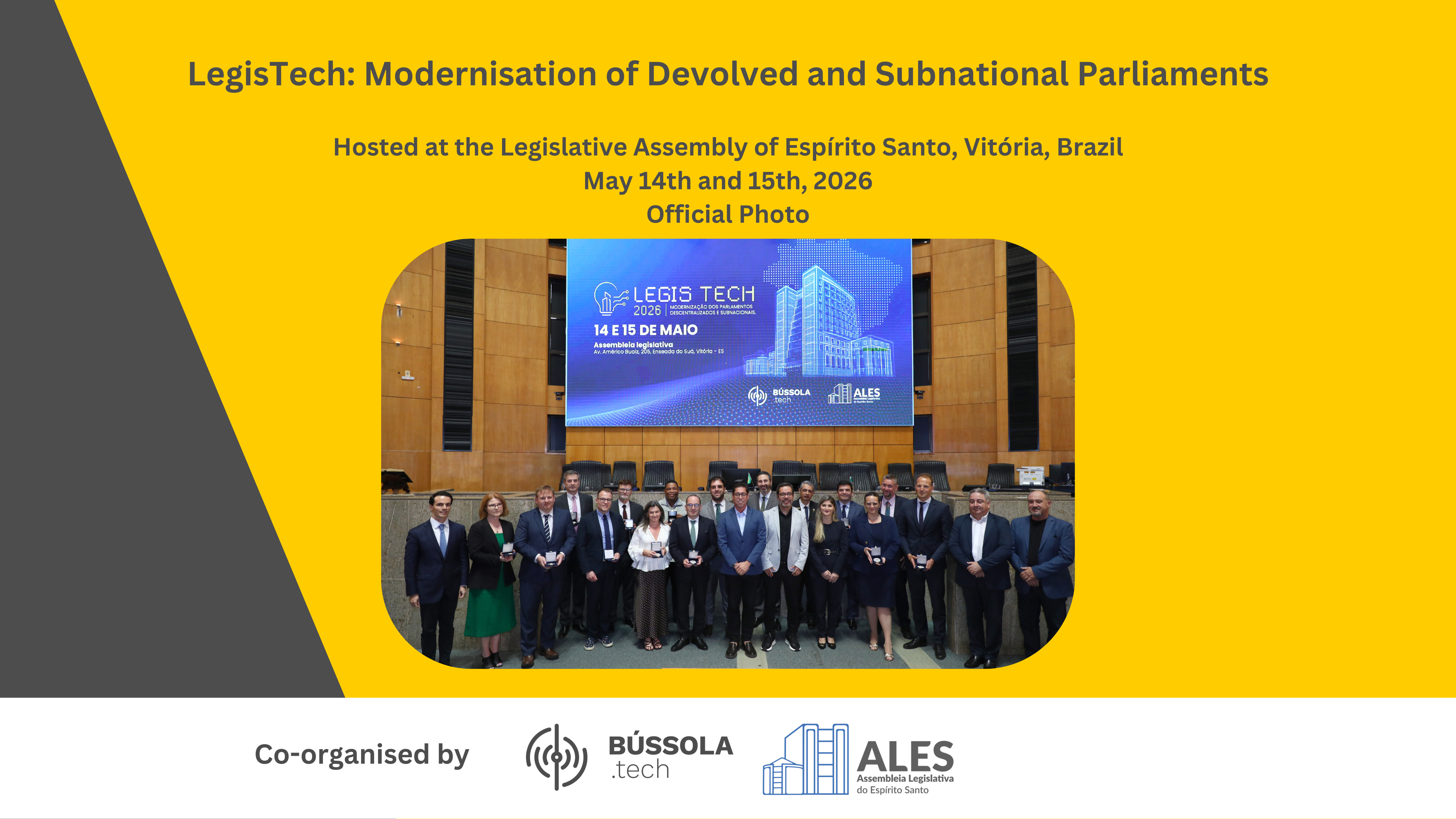
Photos of the event at the end of the publication.
Vitória, Espírito Santo, Brazil — 14–15 May 2026 — Bússola Tech and the Legislative Assembly of the State of Espírito Santo concluded the second edition of LegisTech: Modernisation of Devolved and Subnational Parliaments, held in Vitória on May 14th-15th, 2026.
The two-day international meeting brought together parliamentary leaders, secretaries-general, legislative counsel, technology specialists to examine the practical conditions required for modernising devolved, state, provincial, regional and subnational legislatures.
Hosted by the Legislative Assembly of Espírito Santo, LegisTech Vitória brought together institutional experiences from Brazil, South Africa, Canada, Portugal, Scotland, Australia, Germany, Argentina and the United States. The programme addressed digital legislative processes, artificial intelligence strategies, parliamentary data, interoperability, legislative drafting, synthetic media and disinformation, legacy systems, governance, long-term planning and comparative modernisation experiences.
Rather than treating artificial intelligence as an isolated technological development, the event considered the wider institutional conditions required for responsible transformation: structured data, human oversight, procedural integrity, information security, staff capacity, accessibility, public trust, continuity and sustainable investment.
Official Opening
LegisTech Vitória was opened by Marcelo Santos, Speaker of the Legislative Assembly of Espírito Santo; Marcos Aquino, Director of Transparency, Innovation and Special Projects at the Legislative Assembly of Espírito Santo; and Luís Kimaid, Executive Director of Bússola Tech. The opening also included remarks by Giuliano Nader, Secretary for Institutional Relations at the Legislative Assembly of Espírito Santo.
Presentation: IA.LES — Artificial Intelligence Programme of the Legislative Assembly of Espírito Santo
The first presentation of the event introduced IA.LES, the Artificial Intelligence Programme of the Legislative Assembly of Espírito Santo.
The presentation was delivered by Marcos Aquino; Carlos Eduardo Casa Grande, Secretary-General of the Board of the Legislative Assembly; Patricia Freire, Legislative Analyst; and Grimaldo Cruz, Director of Information Technology.
IA.LES was presented as an institutional programme designed to integrate artificial intelligence into the work of the Legislative Assembly through governance, staff participation, transparency, public accessibility and human oversight.
The programme includes initiatives to make bills, legislation and parliamentary information more understandable to citizens; improve public access to parliamentary content; support the automation of repetitive internal activities; modernise administrative services; and create more efficient internal workflows.
The presentation also highlighted the Assembly’s approach to responsible AI implementation. Rather than treating AI as a simple product acquisition or an isolated software deployment, IA.LES was presented as a structured institutional agenda involving governance mechanisms, technical teams, public servants, institutional committees, traceability, security and accountability.
Presentation: Modernisation Case of the Western Cape Provincial Parliament
The second presentation examined the modernisation experience of the Western Cape Provincial Parliament of South Africa.
It was delivered by Clarence Esau, Senior Information Technology Strategist, and Coby Skriker, Manager of Information Technology and Digital Services.
The Western Cape case explored how a comparatively small parliamentary administration can develop ambitious digital services through strategic planning, partnerships, internal capacity-building and clear governance arrangements.
The presentation addressed the relationship between technology, people and institutional processes. It considered information architecture, records management, metadata, taxonomies, sensitivity labels, data stewards, service-level agreements, hybrid sourcing models and the need to ensure that digital transformation reaches the daily work of parliamentary departments.
The Western Cape Provincial Parliament also shared practical examples involving digital services, unified communications, training, staff development, information governance and the progressive introduction of technologies capable of supporting more integrated parliamentary operations.
Panel Discussion: First Steps Towards a Digital Legislative Process
The first panel discussion, First Steps Towards a Digital Legislative Process, was moderated by Luís Kimaid.
The panellists were Marcos Aquino; François Gagnon, Research Coordinator of the Public Administration Committee of the National Assembly of Québec; Andy Beattie, Chief Parliamentary Counsel, Scotland; Danilo Aguiar, Secretary-General of the Board of the Federal Senate of Brazil; and Ornela Flavia Vanzillotta, Director of International Relations at the Legislature of Buenos Aires.
The panel examined the institutional starting point for legislative digital transformation. Participants discussed the fact that digitising parliamentary activity is not limited to introducing new software or transferring paper procedures into electronic systems.
The discussion considered how rules of procedure, institutional practices, legislative workflows, parliamentary customs, political agreements and administrative routines must be mapped before they are translated into digital systems.
Andy Beattie emphasised that parliamentary procedure is not merely an administrative workflow, but a democratic and constitutional process shaped by institutional history, convention, political culture and public accountability. The panel considered the need to preserve transparency, procedural integrity, legislative traceability, the rights of Members and minorities, and the legitimacy of parliamentary decisions when designing digital systems.
François Gagnon addressed the contribution of parliamentary libraries, research services and information professionals to digital transformation. He highlighted that legislative institutions produce extensive bodies of institutional knowledge through committees, research services, legislative drafting offices, debates, amendments, reports and procedural records. The challenge is not only to store this information but to organise it in ways that make it accessible, reusable and useful for evidence-based legislation.
Danilo Aguiar discussed the Federal Senate’s experience in building structured digital processes and using technology to strengthen parliamentary services. Ornela Flavia Vanzillotta reflected on the importance of institutional mapping, achievable projects and staff involvement in the design of reforms. Marcos Aquino stressed that digital transformation must be measured by whether it improves the service delivered to citizens and respects constitutional, procedural and institutional requirements.
Presentation: Modernisation Case of the Parliament of the Azores
Sandra Costa, Secretary-General of the Parliament of the Azores, presented the modernisation experience of the autonomous Portuguese legislature.
Her presentation examined how the geography of the Azores, an archipelago composed of nine islands, shaped the Parliament’s early reliance on digital communication, electronic workflows, remote collaboration and online access to parliamentary activity.
Sandra Costa described how the Parliament gradually moved from paper-based procedures to digital communication, electronic document management, databases, online services, semantic search, web transmission and digital workflows. The presentation also considered the role of political support, change management and institutional adaptation in maintaining long-term modernisation initiatives.
The Parliament of the Azores shared experiences with automatic transcription, captioning, search tools, artificial intelligence-assisted summarisation, workflow automation, facial recognition, centralised management of dispersed facilities and AI-supported coding.
A central part of the presentation addressed the Parliament’s work on knowledge management, including the development of structured institutional information, APIs, semantic relationships, ontologies and retrieval-augmented generation systems. The objective is to allow parliamentary users to access interconnected institutional knowledge rather than isolated documents.
Presentation: LegisPro Case of Xcential Legislative Technologies — Data-Driven Legislative Drafting
Grant Vergottini, CEO of Xcential Legislative Technologies, presented the LegisPro case on data-driven legislative drafting.
The presentation focused on the importance of treating legislative information as structured, interoperable and reusable data rather than as static documents designed solely for human reading.
Grant Vergottini examined how legislative drafting systems can support the preparation, amendment, publication and management of legislation while strengthening consistency, traceability, version control and the capacity of institutions to exchange information across systems.
The presentation also addressed the implications of AI for legislative content. It highlighted the importance of designing information systems that serve not only end users but also search engines, automated systems and future AI tools. Legislative institutions must consider how official content is published, structured and made discoverable so that authoritative parliamentary information is not displaced by unofficial or misleading external sources.
The LegisPro case demonstrated that structured legal information, including XML-based standards and legislative models, is a critical foundation for future AI-supported legislative work.
Panel Discussion: Long-Term Planning for the Implementation of Artificial Intelligence and Emerging Technologies in Subnational Parliaments
The final panel of the first day addressed Long-Term Planning for the Implementation of Artificial Intelligence and Emerging Technologies in Subnational Parliaments.
Moderated by Luís Kimaid, the panel brought together Sandra Costa; Moises Benamor, Chief of the Parliament Section at the Organization of American States; Bernice Watson, Director of Chamber and Committee Services at the Parliament of Queensland; Carlos Eduardo Casa Grande; and Juan de Dios Cincunegui, Director of the School of Parliaments at Austral University in Argentina.
The panel examined how parliaments can ensure that modernisation initiatives survive changes in political leadership, institutional priorities, administrative structures and budget cycles.
Participants discussed the risks of isolated pilot projects, short-term funding, fragmented procurement, insufficient infrastructure and the discontinuity that can arise when technology initiatives are not anchored in broader institutional strategies.
Moises Benamor examined the relationship between AI, institutional trust, political legitimacy and long-term investment. He highlighted the importance of stable funding, clear institutional responsibilities, sustained planning and the ability to avoid cycles of underinvestment that lead to weak infrastructure, obsolete systems and reduced public confidence.
Sandra Costa reflected on the balance between preserving valuable parliamentary traditions and avoiding the preservation of practices that no longer serve a functional institutional purpose. She emphasised the need to adopt technology carefully, with attention to reliability, transparency, cybersecurity, ethics and public trust.
Bernice Watson discussed the operational perspective of a subnational parliament, including the need to build sustainable services for Members, committees, reporting, broadcasting, education, libraries, compliance and external relations. Carlos Eduardo Casa Grande presented the experience of Espírito Santo in building long-term institutional support for digital transformation. Juan de Dios Cincunegui examined the political, administrative, procedural and normative conditions required for an AI strategy to become a lasting institutional policy rather than a temporary initiative.
Panel Discussion: Parliamentary Data Structuring - Data Standards and Recommendations for Integration with Artificial Intelligence
The second day began with a panel discussion on Parliamentary Data Structuring: Data Standards and Recommendations for Integration with Artificial Intelligence.
Moderated by Luís Kimaid, the panel included Aleksandar Savanovic, Head of Digitisation in the Digital Parliament Unit of the Legislature of Baden-Württemberg; Roberto Eberhardt, IT Director of the Legislative Assembly of Ontario; Juliano Bringer, CIO of Ágape Consultoria; Grant Vergottini; and Coby Skriker.
The discussion addressed the distinction between parliamentary information that is merely digitised or available online and information that is properly structured, semantically meaningful, machine-readable, governed and suitable for AI use.
Roberto Eberhardt discussed the importance of structured data for repeatability, accuracy and contextualisation in AI systems. He examined how structured information can support retrieval-augmented generation and allow institutions to connect otherwise fragmented resources.
Grant Vergottini reflected on the evolution of public legislative information systems and the risks created when official institutions fail to publish data in formats suitable for modern search engines and AI systems. He argued that legislatures must consider not only how information looks to human users, but also how it can be interpreted and retrieved by automated technologies.
Coby Skriker addressed information architecture, taxonomies, controlled vocabularies, metadata, records management, sensitivity classifications and organisational data stewardship. He stressed the importance of assigning both technical and functional responsibility for data within each parliamentary department.
Juliano Bringer examined the challenge of interoperability across legislative systems. He discussed the need to structure legal texts, relationships among laws, amendments, revocations and procedural information so that AI tools can interpret legislative content accurately. He also emphasised that parliamentary information should be designed for machine consumption as well as human reading.
Aleksandar Savanovic reflected on the need to build shared institutional awareness of data issues across technical and non-technical departments. He described the challenge of ensuring that legal, administrative, operational and service-delivery decisions do not unintentionally create gaps in the parliamentary data environment.
Presentation: Apoia Project — Artificial Intelligence Suite of the Federal Senate of Brazil
Danilo Aguiar presented the Apoia Project, the Artificial Intelligence Suite of the Federal Senate of Brazil.
The presentation examined the Senate’s approach to AI through three complementary pathways: training and responsible use by public servants; centrally coordinated strategic projects; and decentralised solutions developed by individual departments to improve specific processes.
The Apoia Project includes tools and initiatives related to speech-to-text services, transcription review, vocabulary management, simplification of legislative language, document classification, committee referral support, biometric and identity verification solutions, internal information retrieval and analytical support for complex parliamentary materials.
Danilo Aguiar highlighted the Senate’s use of speech-to-text technology to support parliamentary transcription. The system combines automated transcription with human review, glossary development and feedback mechanisms that improve recognition of names, technical terms and recurring parliamentary vocabulary.
The presentation also addressed AI-supported plain-language explanations of legislative content. These tools aim to improve public access to parliamentary information while preserving neutrality and avoiding the introduction of unintended political bias.
The Federal Senate’s experience reinforced the importance of staff training, institutional guidance, data protection, quality control, transparent governance and the principle that AI should support, rather than replace, human judgement.
Presentation: Impact of Disinformation in Subnational Parliaments — The Use of Synthetic Media
Moises Benamor presented Impact of Disinformation in Subnational Parliaments: The Use of Synthetic Media.
The presentation examined the growing risks associated with manipulated audiovisual content, synthetic media, misinformation and the changing digital environment in which parliaments communicate with citizens.
Moises Benamor considered how AI may affect public trust in democratic institutions. He stressed that the challenge is not simply whether parliaments adopt artificial intelligence, but whether they do so in ways that preserve transparency, institutional accountability, the separation of powers and democratic norms.
It also highlighted the need for parliaments to understand the relationship between technological modernisation and public legitimacy. Technology can strengthen institutional capacity, but it does not automatically generate trust. Trust depends on the quality of democratic institutions, transparency, procedural credibility and the responsible use of technology.
Presentation: State of Modernisation of State Legislative Power in the United States
William Clark, Programme Director at the National Conference of State Legislatures, presented the State of Modernisation of State Legislative Power in the United States.
The presentation examined the varied modernisation trajectories of U.S. state legislatures, including differences in institutional structure, staff capacity, technology environments, legislative calendars, procurement arrangements and internal governance.
William Clark presented evidence on the increasing use of generative AI tools by legislative staff. He noted that research, editing, communication, summarisation, transcription, coding and document drafting are among the most common practical applications emerging across legislatures.
The presentation also considered the reality that many legislative staff use AI tools independently, often through personally acquired licences rather than institutionally managed systems. This development increases the importance of clear guidance, staff training, enterprise-level governance, privacy safeguards and institutional policies.
William Clark discussed the operational challenge of modernising complex environments in which state legislatures often rely on a mixture of internally developed systems, vendor-based applications, separate House and Senate technology environments and services managed in cooperation with other branches of government.
The presentation underlined that successful AI adoption depends on developing practical use cases, testing them carefully, demonstrating institutional value and scaling responsibly.
Presentation: Current State of Modernisation in the Argentina Provincial Legislatures
Juan de Dios Cincunegui presented the Current State of Modernisation in the Argentina Provincial Legislatures.
The presentation addressed the diversity of provincial legislative institutions in Argentina and the importance of building networks for training, institutional learning, professional development and comparative exchange.
Juan de Dios Cincunegui considered the relationship among digitalisation, open parliament, public participation, transparency and AI-assisted legislative work. He distinguished between basic digitisation initiatives, broader open-parliament strategies and the more complex challenges associated with artificial intelligence in legislative processes.
The presentation also considered key democratic questions raised by AI. These included the auditability of systems, citizens’ right to understand which technologies have influenced institutional processes and the technological sovereignty of subnational legislatures that rely on infrastructure developed by major global technology companies.
Presentation: Modernisation Case of the Legislature of Baden-Württemberg
Aleksandar Savanovic presented the modernisation case of the Legislature of Baden-Württemberg in Germany.
The presentation explored the work of the Digital Parliament Unit and the importance of building a shared institutional understanding of digitalisation, structured data and AI readiness.
Aleksandar Savanovic discussed how parliament can be understood as a complex institutional platform in which many departments produce, manage and rely on information. He noted that data issues cannot be left only to technical teams, since legal professionals, administrative services, catering, event management, committee support and operational departments all make decisions that may affect the quality, availability and structure of parliamentary information.
The Baden-Württemberg case highlighted the need to create a common organisational narrative around the value of data. The objective is to ensure that non-technical staff understand that data governance affects parliamentary capacity, operational continuity and the ability of future systems to support institutional work.
Panel Discussion: Integration of Artificial Intelligence Tools with Legacy Systems in Devolved and Subnational Parliaments
The final panel discussion addressed Integration of Artificial Intelligence Tools with Legacy Systems in Devolved and Subnational Parliaments.
Moderated by Juliano Bringer, the panel included Grimaldo Cruz; William Clark; Clarence Esau; and Carlos Eduardo Brandão, CEO of Intelliway.
The discussion considered the challenge facing most parliamentary institutions: AI adoption must often occur while legacy systems remain essential to daily parliamentary activity.
Grimaldo Cruz discussed the impact of fragmented data, inconsistent records, old databases and systems that were not designed to support modern interoperability. He emphasised that AI cannot operate reliably where data is not structured, aligned and governed.
Clarence Esau addressed the importance of leadership support, institutional buy-in, user adoption and the need to balance the exposure of existing systems through APIs with the practical capacity of parliaments to maintain those systems securely.
William Clark examined the particular complexity of U.S. legislative environments, where House and Senate systems can be separate, technology responsibilities may be distributed across institutions and legislative services often depend on a mixture of vendors, internal applications and long-standing contracts. He argued that iterative integration is often more realistic than wholesale replacement.
Carlos Eduardo Brandão considered the risks created by legacy infrastructure, including cybersecurity vulnerabilities, isolated data silos and systems that were not designed to provide structured information to AI tools. He outlined a hybrid approach in which parliaments evaluate institutional risk, the stability of existing systems, data readiness and the possibility of introducing intermediary layers or new services.
The panel also examined whether AI should be used to extend existing legacy systems or whether it should become a trigger for rebuilding core applications. Participants concluded that no single answer applies to every parliamentary environment. In some cases, modern APIs, data layers and gradual integration may be appropriate. In others, replacing an obsolete system may be necessary. The choice must be based on institutional risk, continuity requirements, data quality, security, cost and the criticality of each service.
Presentation: LawMaker Case of the Parliamentary Counsel of Scotland
Andy Beattie presented the LawMaker Case of the Parliamentary Counsel of Scotland.
The presentation addressed the role of digital legislative drafting systems in improving the preparation, amendment, management and publication of legislation.
The LawMaker case examined how structured legislative content can support legislative counsel, parliamentary staff, Members and the public. It also considered the need for systems that can preserve the legal and procedural context of legislative material while improving the accessibility and usability of information.
Andy Beattie reflected on the importance of continuous improvement in legislative drafting and the potential of digital systems to improve legislative quality, institutional memory, transparency and public understanding of the law.
The presentation also considered the future relationship between structured legislative systems and AI tools. It stressed that high-quality, reliable legal information requires careful governance, confidentiality protections, secure environments and a clear understanding of the problems that technology is intended to solve.
Presentation: Modernisation Case of the Parliament of Queensland
Bernice Watson presented the modernisation case of the Parliament of Queensland in Australia.
The presentation examined the operational responsibilities of parliamentary services supporting the Chamber, committees, reporting and broadcasting, education, libraries, research, information management, legal compliance and external relations.
Bernice Watson reflected on the realities of modernisation in a subnational parliament, where institutional teams must often deliver a broad range of services with limited staffing and resources. Her presentation emphasised the role of practical organisational design, collaboration across services, staff development, operational continuity and sustained attention to the needs of Members and citizens.
The Queensland case reinforced that parliamentary modernisation is not the responsibility of a technology department alone. It requires engagement from those responsible for procedure, committees, reporting, information management, public education, research, compliance and institutional operations.
Presentation: Modernisation Case of the Legislative Assembly of Ontario
Roberto Eberhardt presented the modernisation case of the Legislative Assembly of Ontario in Canada.
The presentation addressed a practical approach to the use of AI and parliamentary information systems. It considered how digital tools can help Members and staff navigate complex repositories of institutional documents without necessarily attempting to replace human expertise or redesign every existing service.
Roberto Eberhardt shared examples of AI-supported information retrieval and document navigation, including approaches that improve the accessibility of internal resources while maintaining established user environments.
The Ontario case demonstrated that not every institutional application of AI needs to begin as a major strategic transformation. Carefully designed, targeted solutions can address concrete operational problems and improve the usability of institutional knowledge.
The presentation also addressed the need to evaluate whether a proposed technology solves a genuine institutional problem, respects confidentiality and supports the actual needs of parliamentary users.
Presentation: Modernisation Case of the National Assembly of Québec
François Gagnon presented the modernisation case of the National Assembly of Québec.
The presentation focused on the National Assembly’s approach to AI governance, staff consultation, parliamentary libraries, research services, information management and responsible institutional experimentation.
François Gagnon described the Assembly’s creation of a multidisciplinary working group on artificial intelligence, involving staff from across the institution. The process included consultations with approximately 190 employees and led to governance documents addressing the responsible use of AI, accountability, security of information assets, equity, non-discrimination, transparency, staff development and human autonomy.
The National Assembly of Québec also established an intersectoral committee on artificial intelligence, bringing together representatives from information technology, communications, parliamentary affairs, library services and other administrative units. The committee supports institutional monitoring, staff training, risk documentation and coordinated reflection on AI-related developments.
The presentation emphasised the central role of parliamentary libraries and research services. These units are not only repositories of information but also institutional specialists in classification, evaluation, verification and knowledge organisation. The Québec case showed how these services can help parliaments respond to new demands, including fact-checking AI-generated material and advising users on the productive and responsible use of emerging tools.
Presentation: Modernisation Case of the Legislature of Buenos Aires
Ornela Flavia Vanzillotta presented the modernisation case of the Legislature of Buenos Aires in Argentina.
Ornela Flavia Vanzillotta reflected on the transition toward electronic files, remote sessions, digital signatures, internal management systems, transparency initiatives and public access to parliamentary information. She also acknowledged the operational reality that digitisation is often incomplete, with processes sometimes retaining paper-based requirements even after electronic systems are introduced.
The presentation distinguished among three connected but separate dimensions of parliamentary modernisation: digitisation, open parliament and artificial intelligence. Digitisation includes electronic records, digital signatures, remote proceedings and internal systems. Open parliament involves transparency, open data and citizen participation. AI-assisted legislative work includes areas such as bill analysis, normative systematisation, drafting support and regulatory impact assessment.
A Shared Agenda for Subnational Parliamentary Modernisation
The event showed that there is no single path to a digital parliament. Institutions operate under different constitutional frameworks, procedural traditions, budgets, technology environments, staff structures and political realities.
However, the discussions also demonstrated a shared agenda. Parliamentary institutions must strengthen digital legislative processes, structure and govern their data, preserve transparency and procedural integrity, invest in staff capacity, manage legacy systems responsibly, develop sustainable strategies and ensure that artificial intelligence remains subject to human judgement, institutional oversight and democratic accountability.
By bringing together practical cases, technical expertise and institutional perspectives from multiple jurisdictions, LegisTech Vitória strengthened an international community of practice committed to making devolved and subnational legislatures more resilient, accessible, transparent and prepared for the opportunities and challenges of artificial intelligence.
Photos of the event




Co-Organized by