Panel Discussion about the Increase the Accuracy of Speech to Text Technologies in Parliaments
Webinar hosted by Bússola Tech on June 16th, 2026

Photo from the Discussion
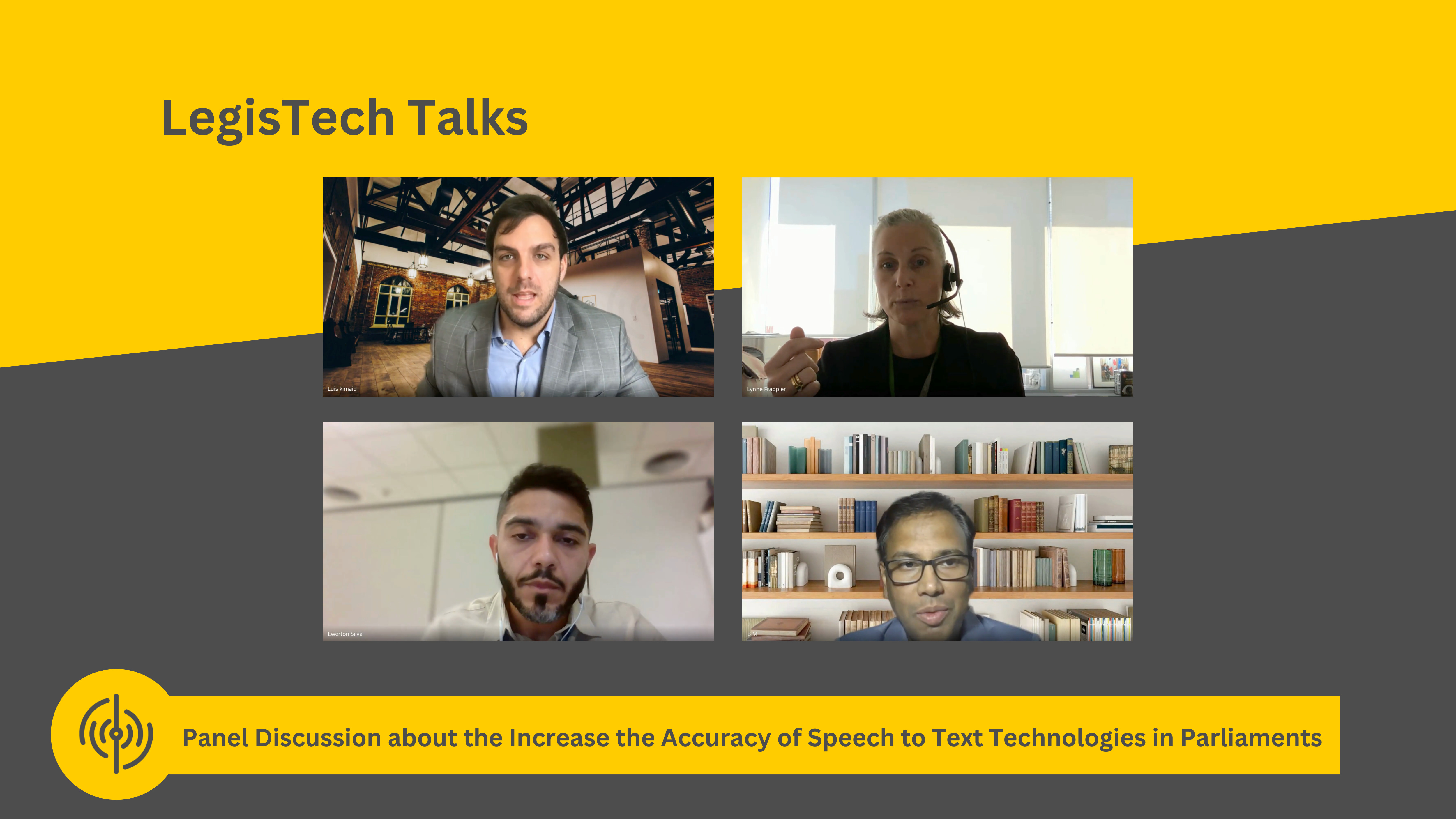
On June 16th, 2026, Bússola Tech convened a LegisTech Talks debate titled “Increase the Accuracy of Speech-to-Text Technologies in Parliaments”, bringing together parliamentary practitioners and technology specialists to explore how legislative institutions can improve the quality, reliability, and adoption of automated transcription systems.
Moderated by Luís Kimaid, Executive Director of Bússola Tech, the panel brought together Lynne Frappier, Head of Publications at the House of Commons of Canada; Ewerton Silva, AI Manager at the Federal Senate of Brazil; and Brahma Mishra, CEO of MeetMonk. The discussion examined both the technical and organisational dimensions of speech-to-text technologies, with particular attention to parliamentary reporting, official records production, multilingual environments, and the integration of artificial intelligence into legislative workflows.
The debate highlighted the growing maturity of speech recognition technologies within parliamentary institutions. Participants described how automated transcription systems have evolved from experimental tools into operational components of parliamentary reporting processes. Experiences from Canada and Brazil demonstrated that speech-to-text solutions are already generating measurable productivity gains, accelerating the production of parliamentary records while reducing manual transcription workloads. However, panellists emphasized that accuracy remains the decisive factor determining whether these technologies can be trusted as part of official legislative documentation.
A central theme of the discussion was the complexity of parliamentary environments compared to conventional transcription scenarios. Participants identified overlapping speakers, multilingual debates, procedural terminology, proper names, changing contexts, and variations in speech quality as persistent challenges. In bilingual legislatures such as the House of Commons of Canada, additional difficulties arise from language switching, translation inconsistencies, and differing expectations regarding how closely parliamentary records should reflect the spoken word. The panel underscored that parliamentary transcription requires far more than converting audio into text; it demands an understanding of institutional procedures, linguistic nuances, and legislative conventions.
The conversation also explored the technological foundations required to improve accuracy. Speakers discussed advances in automatic speech recognition models, audio engineering techniques, speaker identification, diarisation, noise reduction, and contextual processing. While large language models and generative AI systems have significantly enhanced transcription capabilities, participants noted that successful deployments increasingly depend on sophisticated engineering layers built around these models. Rather than relying solely on external APIs, organisations are investing in custom workflows, validation mechanisms, contextual references, and quality-control processes designed to reduce hallucinations and improve consistency.
Artificial intelligence was examined as a transformative force extending beyond transcription itself. Participants outlined how speech-to-text technologies can be combined with generative AI to support summarisation, translation, indexing, metadata generation, speaker identification, document classification, and the production of parliamentary records. Future systems may automatically extract decisions, generate committee minutes, identify procedural actions, and create structured data that can be reused across multiple parliamentary services. At the same time, the panel stressed that these capabilities require strong governance and human oversight to ensure that official records remain accurate and faithful to parliamentary proceedings.
Another recurring theme was the importance of the human dimension in digital transformation. While technological advancements received considerable attention, speakers argued that organisational readiness, staff training, and cultural adaptation are equally important. The successful adoption of speech-to-text technologies depends not only on software and infrastructure, but also on helping parliamentary staff understand how their roles evolve in an AI-assisted environment. Rather than eliminating human expertise, participants described a transition in which employees move from manual transcription tasks toward quality assurance, critical review, and editorial decision-making.
The panel concluded with reflections on how parliaments beginning their speech-to-text journey should approach implementation. Participants recommended starting with clear institutional objectives, carefully evaluating available technologies, continuously monitoring results, and maintaining realistic expectations regarding accuracy. Human supervision, iterative improvements, and sustained investment in staff capabilities were identified as essential success factors. Rather than viewing speech recognition as a standalone technology project, the discussion framed it as part of a broader transformation of parliamentary information management and legislative knowledge systems.
In conclusion, the debate reaffirmed that increasing the accuracy of speech-to-text technologies requires a combination of technological innovation, institutional expertise, and organisational adaptation. While artificial intelligence is rapidly expanding what is possible in parliamentary reporting, the production of trustworthy legislative records continues to depend on careful governance, human judgement, and a clear understanding of parliamentary procedures. By combining advanced transcription tools with strong institutional practices, parliaments can significantly improve efficiency while preserving the integrity and reliability of their official records.
Strategic Partners: